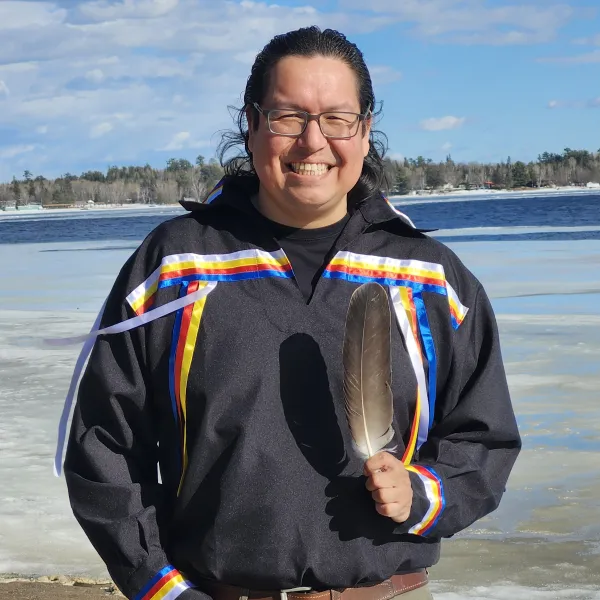
Jeff Copenace
3,499 days sober
Openly Sober recently connected with Jeff Copenace for a written interview about their journey to long-term sobriety. You can find them at @ChiefCopenace.
Where did you grow up and what shaped who you are today?
I grew up in northern Ontario, Canada. I was born and raised in Kenora, but I am from the Ojibways of Onigaming First Nation.
I had a good childhood with good parents and awesome siblings, Darren and Jenny. I had a good education and healthy friendships, and I spent a lot of my teenage days at traditional Anishinaabe powwows and ceremonies with my mother, brother, and sister. I also played hockey and golfed a lot with my father at a young age.
I was well-liked and successful at both school and sports, but I was also secretly depressed as a teenager and young adult.
I suffered sexual abuse as a very young child that my family didn't know about. I'm only starting to talk about it recently.
My family all went to residential schools in Canada, where almost all of them were abused. That is something we are all still healing from.
What was your life like before you got sober?
My life had been mostly positive until I began drinking heavier and heavier as an adult.
I experienced professional success early in my life, including working for the Canadian Prime Minister and other elected Canadian government officials. I worked in Canadian politics for most of my professional life.
I was called a role model, and I travelled a lot in my late twenties to speak to younger people.
But in my thirties, I began to experience some real-life hardships. A 16-year-old niece of my ex-wife's went missing. She still hasn't been found to this day. Around the same time, a friend died by suicide. Both of those events made my depression worse. I drank more and more to self-medicate. I tried to hide it.
Around the age of 30 is when people started asking me, "When did you start to drink every night?" I became badly dependent on alcohol. My life got painful and scary.
When did you first realize you had a problem, and what finally led you to seek help?
I think I knew I had a problem once I started to seek alcohol every day. I was in denial, but deep down I probably knew it.
In my mid-thirties, I suffered a really bad concussion. I could no longer hide my addiction after that. Previously, I had been able to hide my addiction as a functional alcoholic.
But after the accident, my blackouts got crazy. I once took a flight to Vancouver and woke up in Saskatoon. That's a totally different province. I'm guessing I was asked to leave the plane for intoxication, but I still don't know what happened to this day.
Then I started to get really suicidal when I couldn't stay sober. I started coming out of my blackouts on bridges quite a few times. One time I woke up on train tracks when a train started beside me. I barely escaped. Those were some terrifying years in my life.
The withdrawal symptoms were the worst pain ever. My life became a daily hell of shakes, sweats, itching, no sleep, spitting up blood, pains in my abdomen, and sores from malnutrition. When I drank, they would all go away. It was a vicious cycle.
I was finally scared enough for my life to call a helpline at Christmas 2016.
How did you get sober?
I had to go to treatment centres multiple times. The first time in treatment, I stayed sober 92 days before I relapsed.
The second time I went to treatment, I only stayed sober three weeks. I started to travel for work after treatment. I thought I could hide my drinking on the road, but then I couldn't stop drinking when I got back home from the road trip.
The third time in treatment finally stuck. I have thankfully been sober ever since.
I also went to treatment a fourth time, after my sister passed away in 2024. I started to really worry about my mental health. I took my sister's death hard, and I was worrying my then-girlfriend. So I asked for help and went to treatment a fourth time. And it helped me turn things around.
What is your sobriety date, and have you had any relapses or setbacks along the way? If so, what did you learn from it?
My sober date is March 19, 2017. A big part of the reason that I stayed sober is that I traveled to Ottawa, the nation's capital, for an aftercare treatment program at the Wabano Centre for Aboriginal Health.
It was the first time that I did an aftercare treatment program following a treatment centre stay.
I also declared my sobriety publicly on social media. Not everyone in my support group agreed with this, but I found that it's helped keep me accountable.
On the bus ride to Ottawa in 2017, I hashtagged my social media #SoberGangster. I still use the hashtag. Lol.
What does maintaining your recovery look like day-to-day now?
I try to keep a routine.
At nine years sober, I have taken up the treadmill and lifting weights. I have been doing this four or five times a week for the past year.
I am spiritual, so I am involved in prayer and ceremony regularly in my First Nation community.
I try to get eight hours of sleep a night. I can't do my work if I am not properly rested.
Almost every night, I say a brief prayer to thank Creator for my sobriety before I go to bed. I've kept this routine going since 2017.
I meet with a professional counsellor once a month. This is helpful not only for sobriety but for mental health. And my counsellor is also sober, which helps me relate to him.
What has surprised you most about recovery?
I struggled with anger issues in early sobriety. My counsellor said, "It's the first time you have ever had boundaries in your life. So you are getting angry that people are now crossing your boundaries." It was a true statement. But having personal boundaries has helped keep me sober.
This is going to sound funny, but I honestly thought that everybody who got sober turned into a good person automatically. Lol. This is not true. Haha. I have met some horrible, miserable sober people.
For me, being honest and truthful is a big part of my sobriety. During my first treatment stint, I didn't care for this one guy much, but I heard him say something that stuck with me. He said, "Stop doing things that you can't talk about." That made a lot of sense to me. Basically, stop keeping secrets. It just goes to show that you should listen to everyone who has a sober story, because you never know what you might learn or pick up as a habit.
Also, when I went to treatment the fourth time, after my sister passed away, I thought I would be negatively judged as an elected official. But because I was honest about it, I was welcomed back to my community and received even more support than before I left.
Who are the most important people in your recovery journey?
The most important people in my recovery journey are the people that I am helping.
What I have learned about sobriety is that the easiest way to stay sober is to help others get sober.
In my role as elected Chief of my community, we try to celebrate sobriety as much as possible.
This year, we are opening our first-ever community Sober Living Home, which will be a place with five safe, sober beds for aftercare treatment clients and AA/NA programming.
What have you accomplished in sobriety that wouldn't have been possible before, and how do you feel about your life today?
If I wasn't sober, I would be a terrible Chief or a poor elected official. I don't think I would be truly honest or a good role model if I were still drinking alcohol every day and night.
Sobriety has given me the opportunity to mentor younger people and help those in need.
My health is also incredible today, which I could not say nine or ten years ago. Before I got sober, I spent a lot of time in hospitals with early-stage liver and heart disease. Both have completely reversed in sobriety.
Before I got sober, I was sick constantly. Today, I barely remember those nightmarish days and nights.
What advice would you give someone starting this journey to recovery?
A few things people have told me:
A counsellor named Carrie in 2017 told me to stay on my sober path and not to leave it for anybody. That includes family and friends. "They will come to you," she said. "Don't leave the path." She was right. It took many years to earn people's trust back, but all my good friends and family have come back into my life. They came to me. So stay on your path.
Another counsellor told me, "Don't stop trying to get sober, even if you relapse over and over again. Keep trying. Don't stop trying." That's exactly how I got sober. I did it by not quitting and by asking for help.
A substitute counsellor convinced me that my perspective was way off. She showed me that I wasn't nearly as far down the ladder as I thought I was. I had given up on myself completely at that point. She inspired me to try living again. "Just try one more time," she said. "You are closer than you think."
In 2017, I moved away to a place where there are daily recovery meetings and services, including some specifically for Indigenous Peoples. That's Ottawa, in Canada. Smaller towns and First Nations communities in Canada just don't have the same level of addictions recovery services, infrastructure, resources, or programs. Moving away to get more professional help made a big difference for me.
Lastly, if I could take a time machine back to 2015, when I first seriously started to think about getting sober, I would honestly tell myself: "Stop hiding it. Just tell people you need help. You will be surprised at who comes to support you. Even your enemies will cheer for you. It will be different, but you will get your life back."